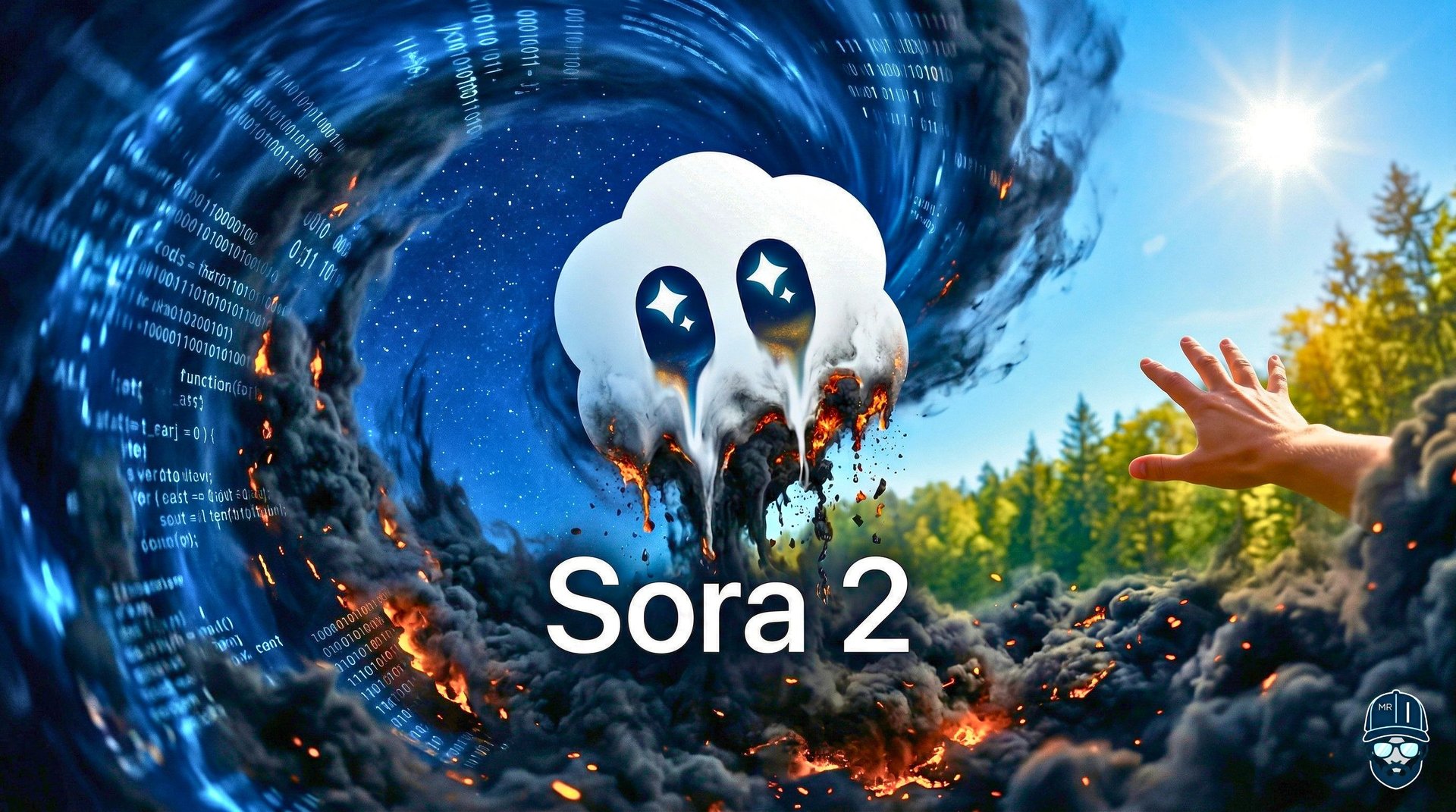
Sora is Dead: Why This Bursting AI Bubble is a Massive Win for Humanity & the Planet
OpenAI officially shut down Sora, its highly hyped AI video generator. But what led to the sudden death of this revolutionary project? We break down the hidden infrastructure crisis behind the scenes, how this massive strategy shift impacts the future of ChatGPT, and why the bursting of the AI video bubble is about to trigger a much-needed reset for the tech industry, human creators, and our environment.
Mr. Influenciado
3/25/20263 min read
The magic is over. When OpenAI revealed Sora to the world, we were swallowed by an almost hypnotic promise: hyper-realistic videos generated from a few lines of text. Mammoths walking in the snow, trains cutting through futuristic cities, the impossible rendered in seconds. But behind the curtain of this digital spectacle, the reality of the servers told a very different story.
OpenAI's decision to completely shut down Sora—closing the official app, cutting API access, and discontinuing its integration across their products—isn't just a product roadmap failure. It's a symptom. It is the first major tremor signaling the bursting of the "AI bubble." And surprisingly, this might be the best thing to happen to the market, to human creativity, and, fundamentally, to our planet.
The Anatomy of a Shutdown: The End of "Side Quests"
Confirmation came via X (formerly Twitter), with the Sora team bidding farewell to their community. The official justification floated around restructuring, but behind the scenes lies a scenario of corporate survival.
OpenAI, until then riding the crest of the wave with a "do everything everywhere all at once" strategy, realized it was bleeding. We saw the launch of search competitors (SearchGPT), browsers (Atlas), audio generators (Jukebox), and speech-to-text models (Whisper). But, as the company's own leadership pointed out, they could no longer afford to miss the moment by being distracted by "side quests."
The corporate market demands productivity and code, not a hyper-realistic, extremely expensive meme generator.
The Compute Bottleneck: Why Did Sora Fall?
To understand the fall, we need to look at the machines. Artificial intelligence today is living through a compute crisis. Generating high-fidelity videos requires a colossal amount of energy and processing power.
OpenAI found itself at a brutal crossroads:
The Hunger for GPUs: Every Sora video competed for resources with ChatGPT and coding tools, which are the company's true financial engines.
Unfair Competition: Chinese models like Kling and Vidu, alongside Google's Veo, began to surpass Sora. The crucial detail? Google doesn't depend on AI to survive. With the search engine and YouTube ad machine bankrolling the operation, Google can subsidize video research in a way that OpenAI—dependent on subscriptions and APIs—simply cannot.
The ROI Dilemma: Once the initial shock faded, Sora's real-world utility proved scarce. The novelty evaporates when businesses realize they can't integrate random, imprecisely controlled videos into their serious workflows.
The Domino Effect: Spud, AGI, and the Focus on the Core Business
The sacrifice of Sora has a clear purpose: redirecting the entire arsenal of talent and computational power to the core business. OpenAI is consolidating its forces into a desktop "super app" focused on productivity for the average user and, more importantly, the enterprise client.
Furthermore, there's the ghost of the next big step. Sources indicate the imminent arrival of the model codenamed Spud—not just a fine-tune, but a complete, unprecedented training run. The internal narrative is that AGI (Artificial General Intelligence) is on the horizon, and any megawatt spent rendering Donald Duck with a lightsaber (fruit of the billion-dollar Disney deal, now in jeopardy) is an unacceptable delay.
The Bursting of the Bubble:The New Dot-Com Crash
We are reliving the 2000s. Just as the dot-com bubble wiped out companies that had no business model other than a ".com" in their name, the AI bubble is starting to punish unsustainable projects. The endless venture capital money is drying up for ideas that are just "cool."
The market is going through a Darwinian filter. Only tools that solve real pains—writing code faster, analyzing complex data, curating knowledge—will survive the hardware and energy scarcity.
The Necessary "Reset": A Breather for the Physical World
The end of the "Sora-for-everything" era carries deeply positive consequences for society, countering the initial doom and gloom:
Immediate Environmental Relief: AI-focused data centers devour electricity and drinking water (used for cooling) at alarming rates. Slowing down the synthetic video race gives vital breathing room to energy infrastructures and local communities that are already overburdened.
The Return of the Human Factor: The promise that AI would replace filmmakers, animators, and art directors hits the brakes. Without the crutch of cheap video automation, the creative industry returns to relying on what makes us unique: aesthetic judgment, human experience, and a worldview that no language model possesses. It's an antidote to the massification of hollow content.
Decentralization and Privacy: With the slowdown of models that require the rampant scraping of visual data from the internet, we buy time to establish more solid privacy barriers and copyright protections.
Waking Up from the Hype
The fall of Sora is not the end of the AI revolution. On the contrary, it is the end of its reckless infancy. It is the transition from a magic show to serious engineering.
When the smoke from this burst bubble clears, what will remain is a technology more rooted in reality, focused on expanding human capability rather than trying to replace it with empty simulations. The end of Sora reminds us of a vital lesson: the digital world must serve the physical world, operating within its laws and limits, not the other way around.