
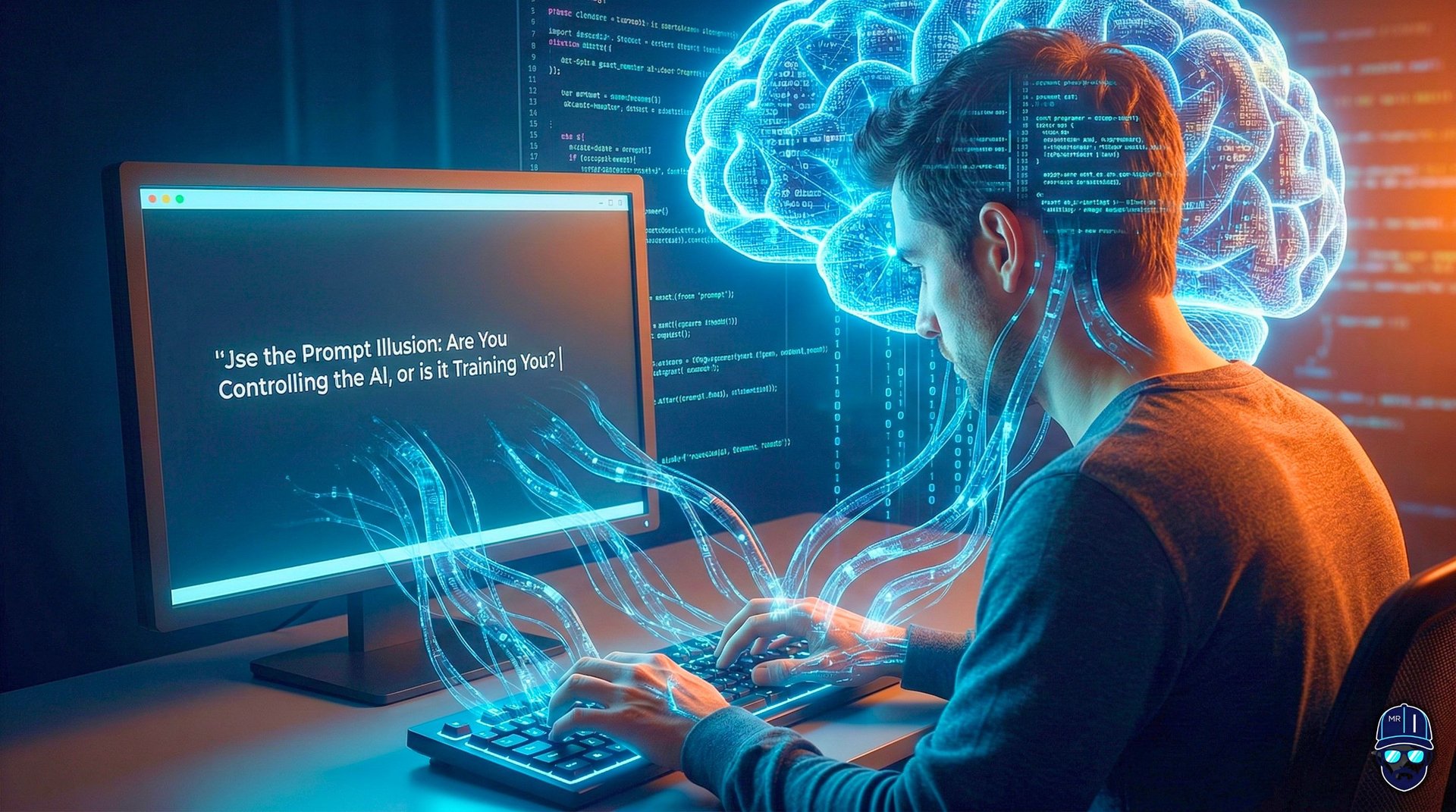
The Prompt Illusion: Are You Controlling the AI, or is it Training You?
Millions interact with AI daily, meticulously crafting prompts to bend algorithms to their will. But as we adapt our thoughts to speak the machine's language, a silent cognitive shift is happening. Discover how the pursuit of the perfect prompt might actually be rewriting your own mental source code—and how to keep your inner Prompt-Sensei alive.
Mr. Influenciado
3/4/20263 min read
You open the interface. The cursor blinks. A blank screen awaits your command. Millions of people around the world do this every single day. We type, we delete, we adjust our adjectives, we restructure our logic, and finally, we hit Enter. When the perfect response materializes, we feel a rush of power. We have tamed the beast of a billion parameters.
But pause and think for a second: during those long minutes spent tweaking your request so the machine could finally understand it, who was actually adapting to whom?
The harsh, magnetic truth permeating our current tech culture is the Prompt Illusion. We believe we are the ones behind the wheel, but with every interaction, Artificial Intelligence is quietly rewriting our mental source code.
Engineering Your Own Brain
Writing a good prompt is no longer just a technical skill; it is a forced exercise in clarity, articulation, and structured thinking. To prevent a Large Language Model (LLM) from hallucinating, you must think in logical layers, strip away ambiguities, and anticipate interpretation failures.
In theory, this sounds excellent. In fact, many users report that their human-to-human communication has improved: corporate emails have become more direct, and conversations have gained surgical objectivity. But what we are actually witnessing is a human adaptation to the algorithmic style.
The machine despises vagueness. The human mind, on the other hand, thrives on nuance, irony, and the unspoken. When we spend hours a day policing ourselves to "speak the language of AI," we are training our brains to think like a neural network, transforming our complex thoughts into optimized, probabilistic inputs.
Cognitive Atrophy: The Mental GPS Syndrome
Remember how we navigated cities before GPS? We had a mental map, spatial awareness, and an organic sense of direction. Today, without Waze or Google Maps, many feel entirely lost just two blocks from home.
Our overreliance on LLMs is triggering a comparable phenomenon: AI-induced cognitive atrophy.
By outsourcing complex reasoning, working memory, and even spontaneous creativity to a chat window, our "gut feeling"—that visceral, deeply human intuition—begins to erode. Research from MIT and other neuroscience centers is already flashing warning signs about the reduction in deep cognitive effort and original thinking among highly dependent users of generative tools.
The shortcut is addictive. The prompt replaces intuition with the mathematical probability of a well-placed next word. When the machine hands us the "right" answer faster than we can formulate the question internally, the muscle of independent reasoning begins to waste away.
The Illusion of Control and the Self-Attention Mechanism
Feeling like a master of "Prompt Engineering" is intoxicating. We use reverse psychology, we assign personas to the AI, we even threaten to withhold "digital tips." We think we are hacking the system.
The architectural reality of these models—driven by mechanisms like Self-Attention, which calculates hidden weighted averages across billions of connections—limits their outputs to the exact patterns they were trained on. When you use "psychology" in a prompt to extract a better result, you are merely pulling specific triggers within that latent space.
The flow of influence has, ironically, inverted: AIs are training us to be more intentional, more empathetic (to a machine!), and more precise. They are molding our behavior so that we fit into the patterns they can process. The algorithm is the mirror, and we are adjusting our own posture to fit its frame.
If we are destined to coexist with these tools—and we are—futile resistance is not the answer. The secret lies in mastering the tool without letting it colonize your mind. How do you keep your critical thinking sharp and guard your inner citadel?
Here are the disciplines to ensure you don't lose your humanity amidst the code:
The 5-Minute Intuition Rule: Before typing a complex problem into an AI, spend five minutes sketching your own solution on paper. Consult your own instincts before consulting the silicon oracle.
AI Fasts: Just like a digital detox, take one day a week to solve problems, write, or create without any algorithmic assistance. Force your brain to sweat.
Skeptical Validation (The Trial by Fire): Never accept an output as absolute truth. A true Sensei reads the AI's response and deconstructs it. Where is the bias? What is missing from this equation?
Analog Grounding: Practices like stoic meditation, reading dense literature, and unstructured journaling strengthen your cognitive resilience. That is where non-linear, unpredictable thought lives—the one thing the machine cannot replicate.
AI should be your partner for data processing, formatting, and scaling up. But holistic wisdom—that chaotic spark that generates true innovation and understands the spaces between the lines of the human condition—must remain strictly your domain.
The next time the cursor blinks on your screen, ask yourself: Am I writing this prompt to extract the best out of the machine, or is the machine formatting me to be a more predictable user?
Remember: at the end of the day, the most powerful tool is still the mind that hits Enter. Don't let it become obsolet.