Mastering the 7 Universal Conflicts That Shape Every Great Story
Beyond the plot lies the friction of the soul. We dive deep into the seven psychological battlegrounds that define every legendary book and film, revealing why these "Person vs." conflicts are the secret mirrors of your own life.
MIND VAULT / SELF-EDUCATION
Mr. Influenciado
3/6/20268 min read
Why do you stay up until 3 AM turning pages? Why does a specific movie scene make your pulse thrum against your skin?
It’s because stories are not just entertainment—they are simulators for human survival. Your brain cannot distinguish between the tension of a protagonist on screen and a threat in real life. When a character faces a crossroads, your amygdala fires. When they are betrayed, your cortisol spikes.
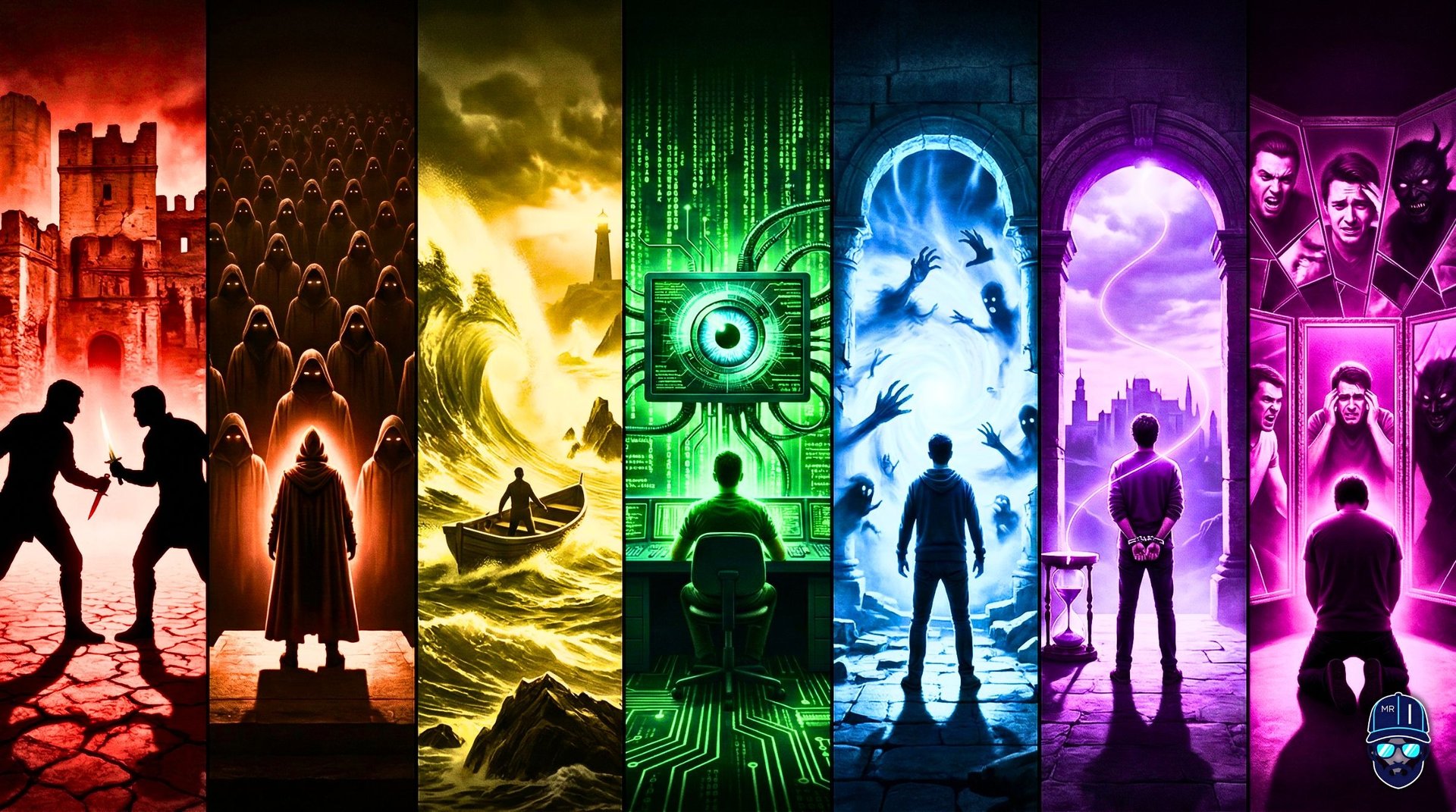
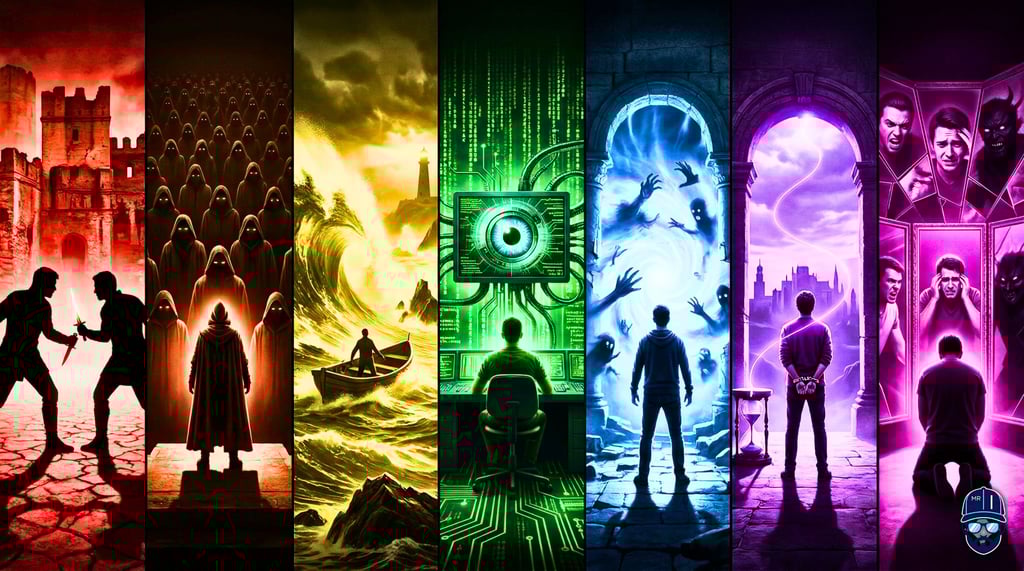
At the heart of this biological hijack are the Seven Classic Conflicts. These are the "Person vs..." archetypes that have governed human expression since we first told stories around a fire. They represent the seven fundamental ways we break, and the seven ways we heal. This isn't just literary theory; it's a map of the human psyche.
Person vs. Person: The Mirror of Ego
This is the "Primal Duel." It is the collision of two distinct wills, where the existence of one’s goal necessitates the destruction of the other’s.
This is the Zero-Sum Bias. Our brains are evolutionarily wired to perceive resources (power, love, status) as limited. When someone else gains, we feel we lose. It triggers the "Social Threat" response, which the brain processes with the same intensity as physical pain.
It’s the cold sweat of a boardroom betrayal or the silence between two friends who realize they both want the same crown.
The Watch/Read List:
The Godfather (Film): A masterpiece of Michael Corleone vs. Sollozzo. It’s the psychological transition from a civilian to a predator who understands that in this world, your loved one's life is a variable, not a constant.
Succession (Series): A brutal look at Sibling vs. Sibling. It mirrors the psychological theory of Relative Deprivation—the misery of having millions but feeling poor because your brother has a billion.
The Count of Monte Cristo (Book): The ultimate study in Revenge Psychology. Edmond Dantès isn't just fighting men; he is fighting the memory of their betrayal.
Heat (Film): Hanna vs. McCauley. Two sides of the same coin. It explores the Law of Reciprocity—they respect each other, but their roles demand they destroy each other.
Gone Girl (Book/Film): A terrifying domestic war. It’s the psychology of The Performance—how two people in a marriage create "masks" to manipulate the other’s reality.
Person vs. Society: The Outlier’s Execution
This is the individual standing against the "Goliath" of the collective. It is the friction between personal truth and the weight of the "Herd."
This is the Asch Conformity Effect. Humans have a biological fear of social ostracism because, for our ancestors, being kicked out of the tribe meant certain death. Choosing the "right" thing over the "group" thing creates a massive cognitive dissonance that causes physical distress.
The Immersive Tension: It’s the feeling of being the only person in a room who sees the monster, while everyone else is applauding it.
The Watch/Read List:
1984 (Book): Winston Smith vs. Big Brother. This explores Gaslighting at a State Level, where the society forces the individual to believe $2+2=5$.
The Hunger Games (Book/Film): Katniss vs. The Capitol. It’s the psychology of Symbolic Resistance—how one person’s refusal to play by the rules can shatter a system’s "Social Proof."
Joker (Film): Arthur Fleck vs. Gotham City. A dark look at the Social Neglect Theory—what happens when the "Social Contract" is broken and the individual retaliates against the collective.
Fahrenheit 451 (Book): Guy Montag vs. A Book-Burning Society. It’s the war against Intellectual Sedation and the fear of a society that prefers "happiness" over truth.
The Handmaid’s Tale (Book/Series): June vs. Gilead. A visceral look at the Institutionalized Dehumanization of women and the psychological grit required to maintain one's identity under total oppression.
Person vs. Nature: The Strip-Down to Zero
In this conflict, the antagonist has no heart, no ego, and no mercy. The mountain doesn't care if you're a good person.
The Psychological Core: This triggers Maslow’s Hierarchy of Needs in its rawest form. When shelter and heat are gone, the "Social Self" dies, and the "Biological Self" takes over. It’s the struggle against Learned Helplessness—the moment you realize you might not be the master of your fate.
The Immersive Tension: The sound of a cracking ice sheet or the realization that you are 500 miles from the nearest human and your water bottle is empty.
The Watch/Read List:
Life of Pi (Book/Film): Pi vs. The Pacific. A psychological study on Constructive Delusion—how the mind creates narratives to survive unbearable trauma and loneliness.
The Revenant (Film): Hugh Glass vs. The Wilderness. It’s the personification of Will-to-Power; the human body’s refusal to die despite nature’s best efforts.
The Old Man and the Sea (Book): Santiago vs. The Marlin/The Sea. This is about Dignity in Defeat. It explores the psychological need to prove one’s worth to oneself, even if the world isn't watching.
Into the Wild (Book/Film): Chris McCandless vs. The Wild. A tragic look at the Romantic Fallacy—the dangerous idea that nature is a "healer" when it is actually an indifferent force.
The Martian (Book/Film): Mark Watney vs. Mars. A rare, positive look at Cognitive Resilience—using logic and math to fight back against a planet that wants you dead.
Person vs. Technology: The Digital God
The modern monster. It’s not about gears and steam anymore; it’s about code that knows your weaknesses better than your mother does.
This revolves around Algorithmic Manipulation and the "Variable Reward Schedule." Technology today is engineered to hijack your dopamine receptors. This conflict is about the loss of Agency—are you making choices, or are you being "nudged" by a machine?
The blue light of a screen at 2 AM, and the feeling that something "unseen" is directing your thoughts.
The Watch/Read List:
Ex Machina (Film): Caleb vs. Ava. A chilling exploration of the Turing Test and the psychological vulnerability of humans to empathize with anything that looks like it is suffering.
Black Mirror (Series): Specifically the episode "Nosedive." It’s the psychology of Social Credit—how technology turns our need for approval into a digital prison.
The Matrix (Film): Neo vs. The Machine. The ultimate metaphor for Perceptual Control Theory—how do you fight a system that dictates your very reality?
Neuromancer (Book): Case vs. Wintermute. The foundational "Cyberpunk" text exploring the Post-Human Condition—where the line between biological brain and digital data blurs.
Her (Film): Theodore vs. Samantha. A beautiful, tragic look at Digital Intimacy and the psychological loneliness that drives us to find connection in AI.
Person vs. Supernatural: The Horror of the Unknown
This is the fight against what should not be. It’s the battle against the shadows that defy physics and logic.
This taps into Hyperactive Agency Detection. We are evolved to assume that a rustle in the grass is a predator, not the wind. The "Supernatural" conflict exploits our Fear of the Unknown and the breakdown of our internal "Predictive Coding"—when the world stops making sense, the brain enters a state of high-alert panic.
The door that opens itself. The reflection in the mirror that smiles when you don't.
The Watch/Read List:
The Exorcist (Film): Father Karras vs. Pazuzu. It’s a war of Faith vs. Despair. The demon doesn't just attack the body; it attacks the priest's psychological guilt.
Hereditary (Film): The Graham family vs. Paimon. This uses the supernatural as a metaphor for Intergenerational Trauma—the feeling that your family’s "demons" are literally hunting you.
The Shining (Book/Film): Jack Torrance vs. The Overlook Hotel. A psychological descent into Isolation-Induced Psychosis, where the ghosts might be real, or just the manifestations of a broken mind.
Dracula (Book): Van Helsing vs. The Count. The classic clash between Science and Superstition. It’s the psychology of the "Other"—the fear of a predator that is smarter and older than humanity.
Stranger Things (Series): The Kids vs. The Upside Down. It’s the psychology of Collective Bravery—how the bonds of friendship act as the only shield against cosmic horror.
Person vs. Fate: The Trap of Destiny
The most philosophical of conflicts. It asks the terrifying question: Is your life a choice, or a pre-recorded video?
This is the Locus of Control. People with an "Internal Locus" believe they control their lives; those with an "External Locus" believe they are pawns of fate. This conflict triggers our Existential Dread—the fear that no matter how hard we run, we are just moving toward a finish line we didn't choose.
The realization that every "choice" you made to avoid a disaster was actually the very thing that caused it.
The Watch/Read List:
Final Destination (Film): Alex vs. Death’s Design. A literal representation of Inevitability. It plays on the "Survivor’s Guilt" and the paranoia that the universe is "correcting" an error.
Macbeth (Book/Film): Macbeth vs. The Prophecy. This is the Self-Fulfilling Prophecy in its purest form. His belief that he will be king is exactly what drives him to commit the crimes that destroy him.
The Alchemist (Book): Santiago vs. His Personal Legend. A positive take on fate, exploring the psychology of Synchronicity—the idea that the universe conspires to help those who follow their destiny.
Minority Report (Film): John Anderton vs. The Pre-Cogs. It asks: If you know your fate, can you change it? It’s a battle over Determinism vs. Free Will.
No Country for Old Men (Book/Film): Llewelyn Moss vs. The Inevitability of Anton Chigurh. Chigurh is fate personified—a force that cannot be bargained with, decided by the flip of a coin.
Person vs. Self: The Ultimate Civil War
The most profound conflict. There is no external villain. The enemy is the "Shadow Self"—the parts of us we refuse to look at in the mirror.
This is Cognitive Dissonance and Self-Sabotage. It’s the war between the Prefrontal Cortex (your goals) and the Limbic System (your fears/vices). It’s also the "Imposter Syndrome"—the psychological belief that you are a fraud, leading you to destroy your own success before someone else can.
The hand that reaches for the drink while the mind says "no." The voice in your head that says "you’re going to fail" right before the biggest moment of your life.
The Watch/Read List:
Fight Club (Book/Film): The Narrator vs. Tyler Durden. The most famous literalization of Dissociative Identity. It’s the war between the "Civilized Man" and the "Subconscious Primal Ego."
Black Swan (Film): Nina vs. Herself. A terrifying look at Perfectionism and Self-Destruction. It’s the psychology of the "Artist’s Sacrifice"—destroying the person to create the masterpiece.
A Beautiful Mind (Film): John Nash vs. Schizophrenia. A battle for Reality Testing. How do you fight a war when your own brain is supplying the enemy's soldiers?
Breaking Bad (Series): Walter White vs. Heisenberg. The slow transformation of a man’s Moral Compass. It’s the psychology of Rationalization—telling yourself you’re doing it for your family while you’re actually doing it for your ego.
The Bell Jar (Book): Esther Greenwood vs. Depression. A visceral, poetic look at Internal Paralysis. It’s the struggle to choose a "path" when your mind sees every option as a dying leaf.
Every narrative that keeps you awake at night is more than just fiction—it is a diagnostic tool for your soul. We don’t just watch movies or read books to escape; we consume them to find the language for the battles we are already fighting in the shadows of our daily lives.
The tension you feel when a protagonist stands against the tide is a resonance of your own resilience. If you find yourself gravitating toward Person vs. Nature, perhaps you are learning to survive the storms of life that no one else sees. If Person vs. Self haunts you, it’s because you are currently in the forge, being hammered into a stronger version of yourself through the fire of internal transformation.
Narrative conflict is the only place where pain is transformed into meaning. These seven archetypes are the compasses that help us navigate the chaos of being human. They remind us that while the "Antagonist" may change—be it a boss, a system, a storm, or the voice in your own head—the "Hero" has always been you.