

The Biggest Bank Fraud in History: What the $10 Billion Banco Master Collapse Teaches the World About 'Safe' Money
The global financial system just received a devastating reality check. With a historic black hole of over R$ 51 billion (roughly $10 billion USD) and a trail of shattered retail investors, the implosion of Brazil's Banco Master is more than a national scandal. It is the ultimate warning that outsourcing the security of your wealth is a guaranteed path to ruin.
Mr. Influenciado
3/5/20264 min read
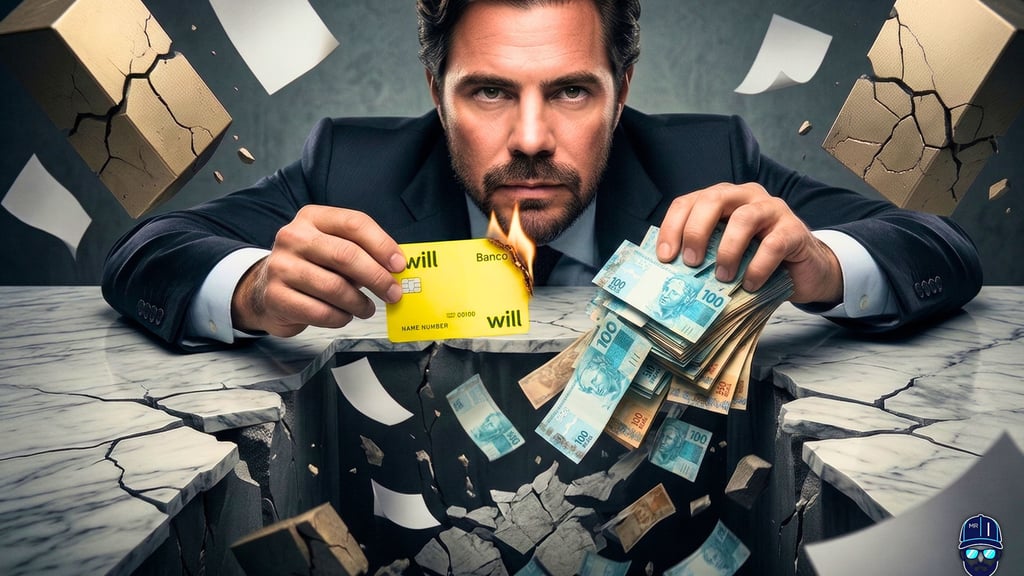

If you believe your money is entirely safe just because your banking app displays a positive balance, it is time to wake up. In February 2026, Brazil's Finance Minister, Fernando Haddad, took to a popular podcast to confirm what institutional insiders had been whispering in absolute panic: the Banco Master fraud is, in his own words, "perhaps one of the largest in the world."
The forced liquidation of the institution by the Brazilian Central Bank (BC) wasn't just another corporate bankruptcy. It was the brutal exposure of a fragile, deeply flawed system, propped up by severe regulatory blindness and pure greed. The bank lured everyday investors with Certificates of Bank Deposit (CDBs) offering mathematically unsustainable yields.
Now, the bill has arrived. Brazil's Credit Guarantee Fund (FGC)—the equivalent of the US FDIC—is being forced to disburse an astronomical R$ 51.8 billion to cover the wreckage. The shockwave was so violent that the Central Bank had to release the compulsory deposits of other national banks just to recapitalize the fund and prevent a systemic, domino-effect collapse.
Here, we don't just read the headlines; we dismantle the machinery behind them. And the raw truth is this: in the modern financial theater, you are the first and only auditor of your own wealth.
The Architect and the Illusion of Easy Money
To comprehend the sheer scale of the abyss, we must look at the man who built the bridge. In 2019, Daniel Vorcaro—heir to a string of failed real estate ventures—took control of a struggling institution called Banco Máxima. By 2021, he had rebranded it as Banco Master.
What followed was a masterclass in colossal accounting manipulation. In just five years, the bank's declared equity skyrocketed from a modest R$ 219 million to an unbelievable R$ 5 billion.
How did they do it? By issuing fixed-income securities (CDBs) at predatory, illusionary rates of up to 130% of the CDI (Brazil's interbank deposit rate), sitting far above the market average of 98%. Banco Master transformed into a black hole, aggressively vacuuming capital from retail investors who were hypnotized by the siren song of guaranteed, sky-high returns.
By December 2024, the alarm bells were deafening at the highest levels of government. Central Bank President Roberto Campos Neto demanded an immediate halt to these abusive issuances and required a R$ 2 billion capital injection under the threat of liquidation. Vorcaro scrambled, attempting desperate and ultimately frustrated sales—including negotiations with the Bank of Brasília (BRB)—but the house of cards was already in freefall.
The Anatomy of a $10 Billion Lie
The mechanics of the fraud were as audacious as they were criminal. The institution artificially inflated highly illiquid, toxic assets—specifically, the debt of deeply troubled Brazilian corporations like Light, Oi, and Gafisa.
With a simple stroke of an accountant's pen, an asset worth R$ 100 was registered on the balance sheet as R$ 1,000.
This feedback loop of fictitious wealth was sustained through suspicious, cyclical operations with funds managed by Reag Investimentos. The result? An estimated R$ 11 to R$ 12 billion siphoned directly into the personal wealth of Vorcaro and his inner circle. This massive embezzlement was funded entirely by everyday citizens buying unbacked, fake securities.
Operating at the absolute edge of the abyss, Banco Master ran at a maximum leverage of 10 times its capital, relentlessly injecting retail liquidity into a toxic wasteland.
Systemic Failure and the Flight to Malta
How does a financial operation of this magnitude go completely unnoticed by the authorities? The answer lies in institutional decay.
Brazil's Securities and Exchange Commission (CVM) was forced to admit its own crippling limitations: with a discretionary budget slashed by 70% since 2015, the agency is tasked with auditing over 30,000 investment funds. This extreme precariousness created a "perverse alignment" between malicious managers and uneducated investors—a dynamic the market cynically refers to as "engana que eu gosto" (fool me, I like it).
The Central Bank itself is currently facing an internal investigation for its sluggishness in detecting and mitigating these glaring risks. Worse still, evidence suggests Vorcaro had privileged, advance access to Federal Police (PF) investigations.
However, impunity reached its expiration date in November 2025. During Operation Compliance Zero, the Federal Police intercepted and arrested Daniel Vorcaro at the airport, moments before he was scheduled to board a flight to escape to the island of Malta. His arrest triggered the immediate freezing of the controllers' assets and a cascade of simultaneous liquidations that dragged down Master Corretora, Master Investimentos, and Reag.
The Retail Slaughter
While regulators trade blame and politicians draft new rules, 1.6 million clients are living a financial nightmare.
The FGC bailouts, which began in January 2026, only cover the legal limit of up to R$ 250,000 per taxpayer. But what happens to those who trusted their entire life savings—amounts far exceeding the cap—to a system they were told was infallible?
The stories flooding the courts are devastating. Take the emblematic case of a doctor who invested R$ 283,000 through the popular NuInvest fintech app. Believing she had made a shrewd, safe move, she watched her digital screen proudly display a fictitious balance of R$ 527,000. Today, she joins thousands of others suing Vorcaro for fraudulent management, fighting a desperate legal battle for the vanished surplus, all while waiting through 30 business days of bureaucratic red tape just to receive the FGC's guaranteed fraction.
They were victims of blind faith in traditional banking and a fundamental misunderstanding of how risk operates.
The collapse of Banco Master is not an anomaly; it is a symptom of a diseased global financial structure. The official narrative will proudly claim that the institutions "worked" and that the guarantee fund stepped in to prevent a macroeconomic meltdown. But the harsh reality offers non-negotiable lessons for anyone who refuses to be the next victim:
Unreal Yields are a Red Siren: If an institution is offering returns wildly above the national baseline, the risk is exponentially higher. Financial "miracles" almost always hide a Ponzi structure or disguised insolvency.
Insurance is a Safety Net, Not a Floor: Government or private guarantees (like the FGC or FDIC) have strict limits. Do not treat these protections as a blank check to dump your entire net worth into dubious, high-yield institutions.
Diversification is Survival: Never concentrate your capital in over-leveraged regional banks or digital brokerages just to chase a few extra percentage points.
Audit Your Reality: The Master case—and the CVM’s admission of absolute weakness—proves that the State will not protect your wealth before the bomb detonates. You must learn to read balance sheets, distrust illiquid assets, and deeply understand exactly where your money is being deployed.
The traditional system thrives on your complacency. Take control.