

The Rise of Agentic AI: Are You Competing With a "Silicon-Based Workforce"?
Forget everything you knew about generative AI. In 2026, generating text is cheap; executing complex decisions is gold. Welcome to the "SaaSpocalypse," a $2 trillion market shakeup where autonomous Agentic AI isn't just assisting humans—it's replacing traditional software, obliterating per-seat pricing models, and creating a relentless new "silicon-based workforce." Here is what you need to know to survive and thrive..
Mr. Influenciado
3/5/20263 min read

If you are still treating AI like a glorified search engine or a high-speed typist, you are already behind.
We are operating in the reality of 2026, and the era of the passive chatbot is dead. The ChatGPTs of the early 2020s—systems that waited patiently for your prompts to generate text—have evolved. Today’s gold standard is Agentic AI: autonomous, proactive intelligence that reasons, plans, and acts. They don't just draft emails; they buy, sell, code, and execute entire operational workflows without you holding their hand.
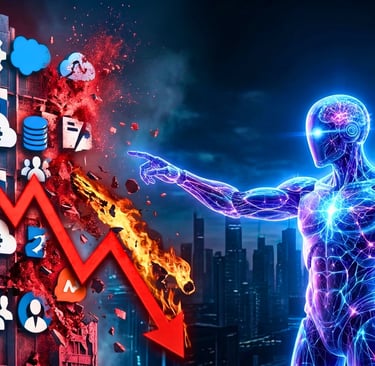
This evolution has triggered a seismic event that Wall Street is calling the "SaaSpocalypse." It is a ruthless market correction where legacy software empires are bleeding value, and professionals are suddenly looking over their shoulders at a new breed of competition: the silicon-based workforce.
The "SaaSpocalypse": A $2 Trillion Wake-Up Call
In February 2026, panic hit the tech sector. The traditional Software-as-a-Service (SaaS) model—built on the lucrative foundation of charging companies "per user seat"—collided violently with Agentic AI. Why pay for 5,000 CRM seats when a swarm of AI agents can manage data entry, initial support, and project orchestration entirely in the background?
The result was a brutal market repricing. As companies began ripping out clunky SaaS interfaces in favor of invisible AI agents, the enterprise software market saw up to $2 trillion in market value wiped out. Anthropic's "Claude Cowork" plugins and OpenAI's aggressive enterprise agents triggered the initial avalanche, proving that AI could effectively replace complex Salesforce, Adobe, and Workday workflows.
Agentic AI isn't a single monolithic brain; it is an ecosystem. We are seeing a massive shift toward multi-agent orchestration, where specialized AI agents collaborate much like microservices in a tech stack. Using protocols like MCP (Model Context Protocol) and A2A (Agent-to-Agent) communication, a "Research Agent" hands off data to an "Analysis Agent," which then instructs a "Purchasing Agent" to execute a transaction.
They form a true silicon-based workforce managed as digital labor. Deloitte recently highlighted that this shift forces a total redesign of corporate processes into "agent-native" workflows, particularly in supply chain and administration. By 2028, it is projected that 15% of all daily work decisions will be made autonomously by AI.
Real-World Infiltration: Who is Hiring Silicon?
The transition is already happening at scale:
Klarna: Completely migrated its tier-1 and tier-2 support from traditional SaaS to an agentic architecture, reducing required software seats by a staggering 25%.
Mapfre: Deployed administrative agents to handle the heavy lifting of insurance claims and data processing, reserving human bandwidth strictly for sensitive, high-touch client interactions.
E-commerce Multi-Agents: Retailers are deploying collaborative swarms where one agent tracks supply, another negotiates delivery rates, and a third personalizes the consumer journey in real-time.
The 2026 Landscape: Trends and Brutal Realities
While the market for AI agents is exploding—projected to skyrocket from roughly $5-7.8 billion to over $50 billion by 2030 (a 45.8% CAGR)—it is not without friction.
The Multi-Agent Boom: Search volume for collaborative AI systems has spiked by 1,445%. A new three-tier ecosystem of "agent-native" startups is emerging to challenge the old guard.
The Governance Trap: Autonomy brings risk. Gartner predicts that up to 40% of enterprise agentic projects will be canceled by 2027 due to spiraling LLM costs (FinOps nightmares) and hallucination risks at scale. Currently, only about 25% of companies manage to push multi-agent systems into stable production.
Are you competing with silicon? Yes. But competition doesnot equal obsolescence—unless you refue to adapt.
Companies must immediately audit their SaaS stacks, identify where they are overpaying for "seats" that agents could fill, and run pilot programs on repetitive workflows. For professionals, the survival strategy is clear: move up the value chain. The bureaucratic, administrative, and repetitive tasks are gone. The most valuable humans in 2026 and beyond are Workflow Architects—the strategists who govern, train, and orchestrate these autonomous agents to drive business outcomes.
You cannot out-work an AI agent. But you can manage them.