
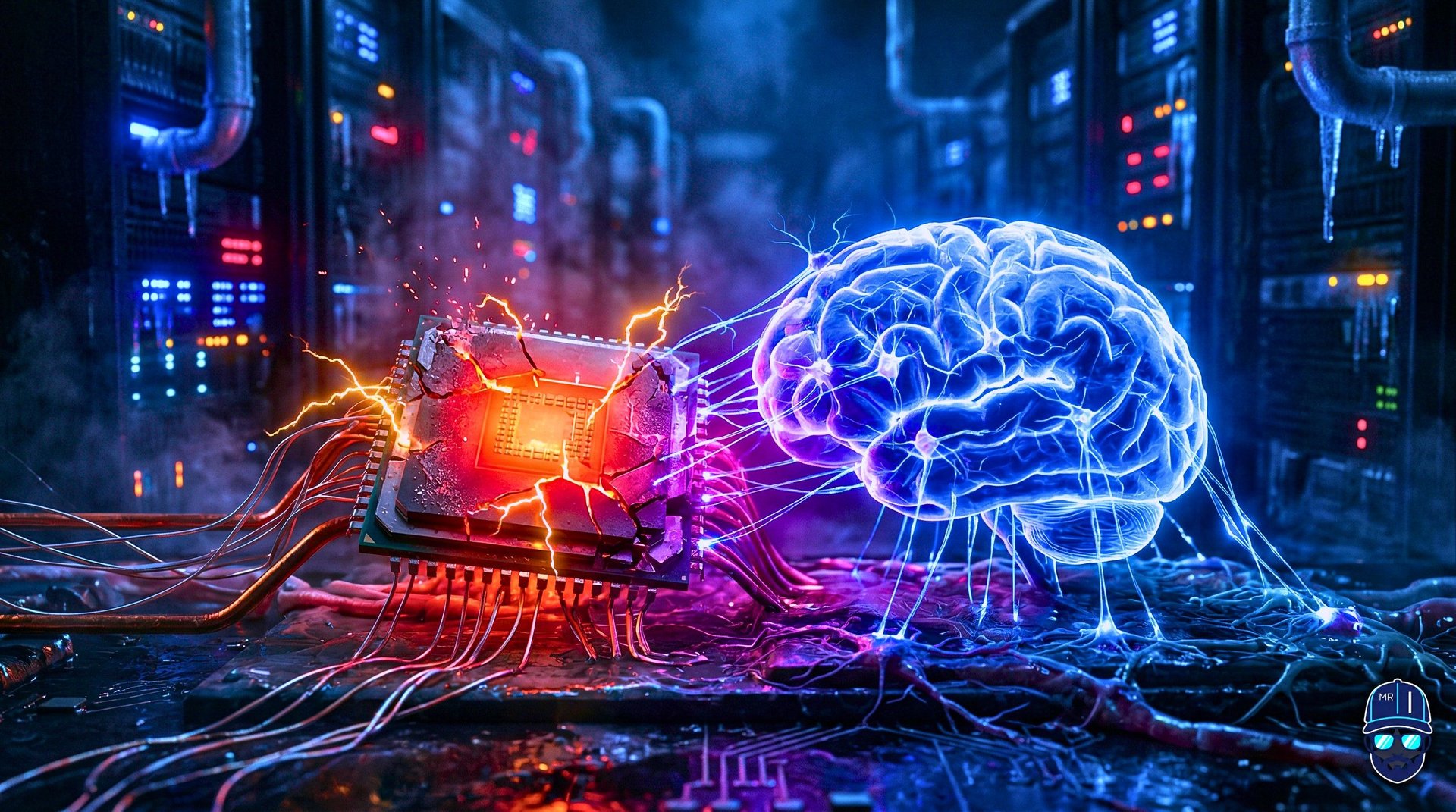
The Cloud is Collapsing: AI's Physical Wall and the Terrifying Dawn of Biocomputing
The illusion of the infinite cloud is dead. AI is colliding with brutal physical and energy limits. Discover what happens when silicon fails, and why the future of computing is terrifying.
Mr Influenciado
3/30/20264 min read
For years, we’ve been sold the comforting illusion of an infinite "cloud." A weightless, ethereal dimension where data and algorithms float freely without friction or consequence. But the reality in 2026 is brutally physical and unapologetically material.
If you walk into a modern mega-data center, you won't find a cloud. You will find massive racks of servers completely submerged in dense, synthetic cooling fluids just to keep the hardware from melting itself down. Artificial Intelligence is colliding at breakneck speed with the absolute physical and energetic limits of our planet. The relentless hunger for processing power and data storage is fracturing our global infrastructure.
From microscopic silicon chips to nuclear-powered server farms, we are hitting the ceiling of what modern engineering can sustain. The defining question of our era is no longer what AI can do, but where it will live when silicon is no longer enough. Are we on the verge of wiring artificial intelligence directly into human brain tissue just to keep the machine running?
Brace yourself. The future of processing is far more organic—and terrifying—than we ever anticipated.
The Silicon Wall and the End of an Era
Moore’s Law—the golden rule that processing power would double every two years—is on life support. This isn't a failure of human genius; it’s a hard limit imposed by the laws of physics.
Modern transistors have shrunk to absurd, atomic scales. At the 3-nanometer (nm) threshold, quantum interference becomes a nightmare, causing current leaks and catastrophic calculation errors. To make matters worse, we are choking on the Von Neumann Bottleneck: the traditional computing architecture that separates the processor from the memory. The sheer act of violently shuttling mountains of data back and forth wastes a monumental amount of time and energy.
The practical result? An unprecedented manufacturing bottleneck. TSMC, the world’s leading semiconductor foundry, has already exhausted its 3nm capacity and is severely severely backlogged on the next-generation 2nm architecture through 2027. The hardware simply cannot keep pace with the software.
The Energy Famine and the New Geopolitics
AI doesn't live in the ether; it burns fuel and boils water. Today, a single AI-dedicated data center consumes the same amount of power as 100,000 homes. The International Energy Agency (IEA) projects global AI energy consumption to hit a staggering 600 TWh in 2026, on track to double by the end of the decade.
This is bleeding into the real world with drastic consequences:
The Grid Collapse: U.S. states like New York are proposing aggressive moratoriums to halt the construction of new data centers. The massive water consumption required for cooling is exacerbating droughts, and the strain on the electrical grid is causing utility bills to skyrocket for everyday citizens. Federal regulation proposals gained serious momentum in March 2026.
The Cloud as a Military Target: Recent drone strikes targeting AWS data centers in the United Arab Emirates prove that digital infrastructure is physical, fragile, and highly contested. The flow of data through the Persian Gulf has become an economic artery just as vital—and volatile—as the flow of oil through the Strait of Hormuz.
The Hyperconnected Expansion: Why Can't We Stop?
If the physical limit is imminent, why don't we just slow down? Because our hyperconnected world demands the exact opposite.
The full realization of the metaverse, smart cities, and autonomous vehicles requires Edge Computing. We have to move processing power away from distant server farms and push it directly to the "edges" of the network—into our AR glasses, our cars, and our phones—to guarantee zero latency.
Furthermore, we have crossed the threshold into the era of Agentic AI. We are no longer dealing with passive chatbots waiting for a prompt. We are deploying autonomous agents that execute complex tasks, monitor infrastructure, and make decisions 24/7. This relentless, background autonomy multiplies the load on global servers exponentially.
Biocomputing: The Meat in the Machine
This is where reality outpaces dystopian fiction. When silicon fails and energy runs dry, science turns to the most efficient processing hardware in the known universe: biology.
Welcome to the unsettling frontier of Organoid Intelligence (OI). Scientists are currently cultivating "mini-brains" in laboratories—cerebral organoids derived from human stem cells—and wiring them directly into circuit boards. This is not a concept for the distant future. These biological systems are already being tested to solve complex problems and even control basic robotics.
Why? Brutal efficiency. While an Nvidia GPU cluster requires hundreds of thousands of watts to operate, the human brain processes infinitely more complex information on a meager 20 watts (roughly the power of a dim lightbulb). Through neuroplasticity—the ability of living cells to physically rewire themselves to learn—these hybrid systems promise a level of parallel processing that shatters the Von Neumann bottleneck and solves the energy crisis in one terrifying leap.
Big Tech’s Desperate Counter-Offensive
The tech titans know the clock is ticking, and they are gambling everything to prevent a processing blackout:
Custom Silicon: Google has aggressively bypassed the open market, deploying its 7th-generation custom TPUs (Ironwood), delivering 4x the performance specifically tailored for AI. Meanwhile, competitors like Meta and AWS are bleeding capital renting out generalized infrastructure.
The Nuclear Option: To feed their digital leviathans, Microsoft signed a historic $16 billion deal to reactivate the Three Mile Island nuclear plant, securing 835MW of dedicated power by 2028. Amazon followed suit, pouring $500 million into Small Modular Reactors (SMRs) to generate 320MW.
Beyond Electrons: Startups and legacy giants like IBM (with its NorthPole chip integrating memory and processing) are abandoning standard electronics for analog computing and photonics—using particles of light instead of electricity to move data instantly and eliminate heat.
The Technological Abyss: The Consequences of Collapse
What happens if these radical innovations arrive too late? The warning lights are already flashing red:
The Bursting Bubble: In 2026 alone, the software sector hemorrhaged nearly $1 trillion in market value due to failed AI deliverables, blocked entirely by physical hardware limitations. With GPU delivery times stretching to 9 months and cloud costs spiking by over 95%, the current model is violently unsustainable.
The Resilience Economy: Processing scarcity is creating a new, insurmountable class divide. Only the hyper-wealthy elite and powerful governments will be able to afford top-tier AI access, creating a technological abyss that mirrors the darkest predictions of Orwellian societal control.
Scientific Stagnation: A hardware bottleneck doesn't just mean slower video rendering; it means delaying the discovery of life-saving drugs, advanced materials, and climate solutions by decades.
The limit of silicon is not the end of Artificial Intelligence, but it is the absolute end of cheap, invisible AI. To make the next leap, we will have to master the atom, harness light, and ultimately, weaponize our own biology.