The Silicon Chokehold: How a Single Stretch of Water Could Crash the Global Economy
What happens when the world’s most advanced technology, nearly half of global maritime shipping, and rising superpower tensions all collide in a single, narrow stretch of water? We break down the ultimate geopolitical powder keg that could freeze the modern economy overnight—and explore why the global race to build a "Plan B" might already be too late.
Mr. Influenciado
3/28/20264 min read
Imagine waking up to a world where the global economy has simply stopped. Dealerships are devoid of new cars, smartphone production lines are frozen, the explosive expansion of Artificial Intelligence has hit a brick wall, and global shipping is in a state of catastrophic paralysis.
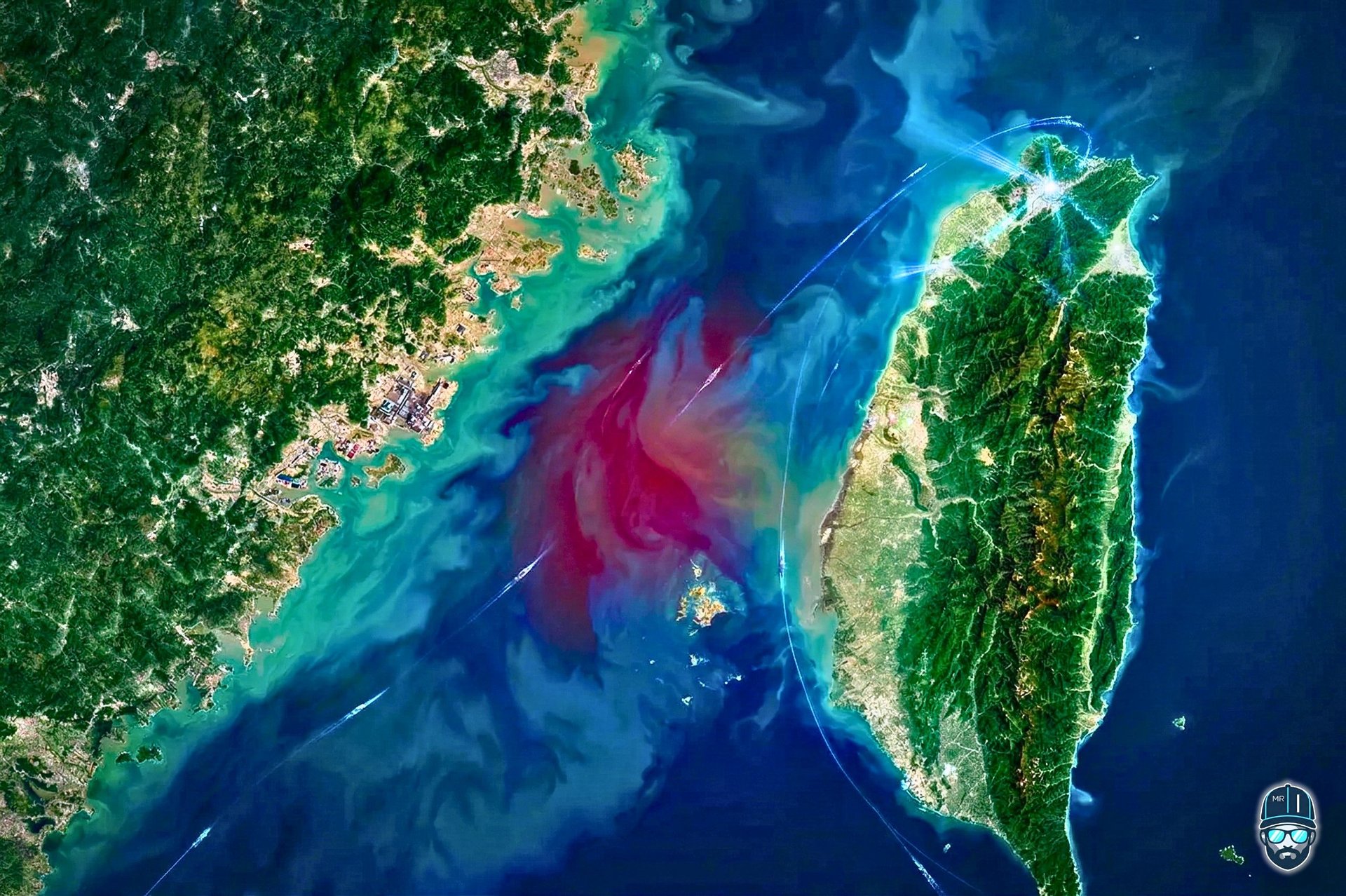
This apocalyptic scenario wouldn't be the result of a sudden pandemic or a devastating meteor strike. It would be triggered by a disruption across a shallow, 100-mile-wide stretch of water in the western Pacific Ocean: The Taiwan Strait.
Far beyond a mere territorial dispute between Beijing and Taipei, this narrow maritime corridor has quietly evolved into the central nervous system of the 21st-century economy. It is the ultimate geopolitical powder keg, and the fuse is burning shorter every day.
The Artery of Global Trade
To understand the gravity of the Taiwan Strait, you first have to look at the water itself. Placed at the volatile intersection of the East China Sea, the South China Sea, and the Philippine Sea, this strait is the inescapable shortcut for global commerce.
The scale of traffic is almost unfathomable. Recent data reveals a staggering 87,000 to 88,000 ship transits annually. But the true vulnerability lies in what those ships are carrying. Nearly 48% of the world’s operational container ships traverse this exact corridor. When we look at the ultra-large container ships (ULCS) that form the backbone of the Europe-Asia routes, that number skyrockets to an astonishing 80% to 88%.
If the Strait were to close, the alternatives are bleak. Rerouting east of Taiwan through the Philippine Sea adds days of transit and massive fuel costs, while the Luzon Strait to the south is fraught with seasonal typhoons. A closure here doesn't just delay shipping; it inflicts a massive, immediate heart attack on the global supply chain.
The Silicon Shield: Forging the Digital Age
If the Strait’s waters are the arteries of global trade, the island of Taiwan itself is the brain. We no longer live in an oil-dominated era; we live in the silicon age. And Taiwan holds an absolute, undisputed monopoly on the future.
Today, roughly 60% of the entire world’s semiconductor production originates in Taiwan. However, the real chokehold is at the bleeding edge of technology. An astonishing 90% of the world’s most advanced chips—the microscopic 5nm, 3nm, and emerging 2nm nodes required to run everything from next-generation smartphones to military-grade AI accelerators—are forged by a single entity: the Taiwan Semiconductor Manufacturing Company (TSMC).
Why can't the world simply build its own chips? Replicating TSMC is not just a matter of throwing money at the problem, though the capital required is immense (a single advanced fab costs upward of $25 billion). Taiwan has spent decades cultivating a hyper-dense ecosystem. It is a fortress built on specialized process engineers, deeply integrated supply chains, and a culture of absolute precision. The world has entirely outsourced its technological evolution to this island, creating what strategists call the "Silicon Shield."
The Ultimate Geopolitical Powder Keg
This concentration of power makes the Taiwan Strait the most dangerous flashpoint on Earth. It is the exact nexus where a fiercely disputed sovereignty claim meets the survival of the global economy, all shadowed by the bipolar rivalry of the United States and China.
The threat of a cataclysmic disruption doesn't necessarily mean a cinematic, D-Day-style amphibious invasion. Beijing possesses a terrifying arsenal of "gray-zone" tactics:
The Silent Chokehold: A prolonged naval and air blockade could restrict commercial traffic and trap semiconductor shipments without a single missile being fired.
Customs Quarantines: Selective denial, targeted sanctions, and severe port inspections could paralyze Taiwanese exports, bleeding the global economy dry through bureaucratic warfare.
Kinetic Strikes: Even a limited military strike on Taiwanese ports or TSMC facilities would instantly vaporize the world's capacity to produce advanced technology.
The $10 Trillion Domino Effect
If the Taiwan Strait goes dark, the fallout will be instantaneous and cataclysmic. Independent macroeconomic models project a global GDP contraction between 2.7% and 5% in the first year alone. In absolute terms, we are looking at the evaporation of $2.7 to $10 trillion in global economic output.
The dominoes would fall across every sector of modern life:
The Tech Blackout: A severe chip shortage would obliterate an estimated $1.6 trillion in touchscreen device revenue.
The AI Freeze: Hyperscalers powering the AI revolution rely entirely on TSMC-made GPUs. A disruption of just six months would cripple cloud expansions and data center builds worldwide.
Industrial Paralysis: Modern vehicles, requiring hundreds of complex chips, would sit unfinished on factory floors. Precision medical equipment, robotic surgery systems, and advanced military radars would face critical, life-threatening shortages.
The Desperate Scramble for Independence
The world has finally woken up to the nightmare of its own making. A desperate scramble is underway to dismantle this dependency. The United States has enacted the CHIPS Act, injecting $52 billion to resurrect domestic manufacturing, while the European Chips Act promises €43 billion to double the EU's market share.
But these are long-term plays in a short-term crisis. Even with TSMC building massive new plants in Arizona and Germany, global reliance on Taiwan for advanced nodes will remain perilously above 80% through at least 2027. True decoupling is a fantasy for the current decade.
The Taiwan Strait is no longer just a regional maritime chokepoint; it is the fragile lynchpin holding the modern world together. Until the global supply chain can fundamentally restructure itself—a process that will take well into the 2030s—our digital lives, our economies, and our future remain at the mercy of the most contested 100 miles of water on the planet.