
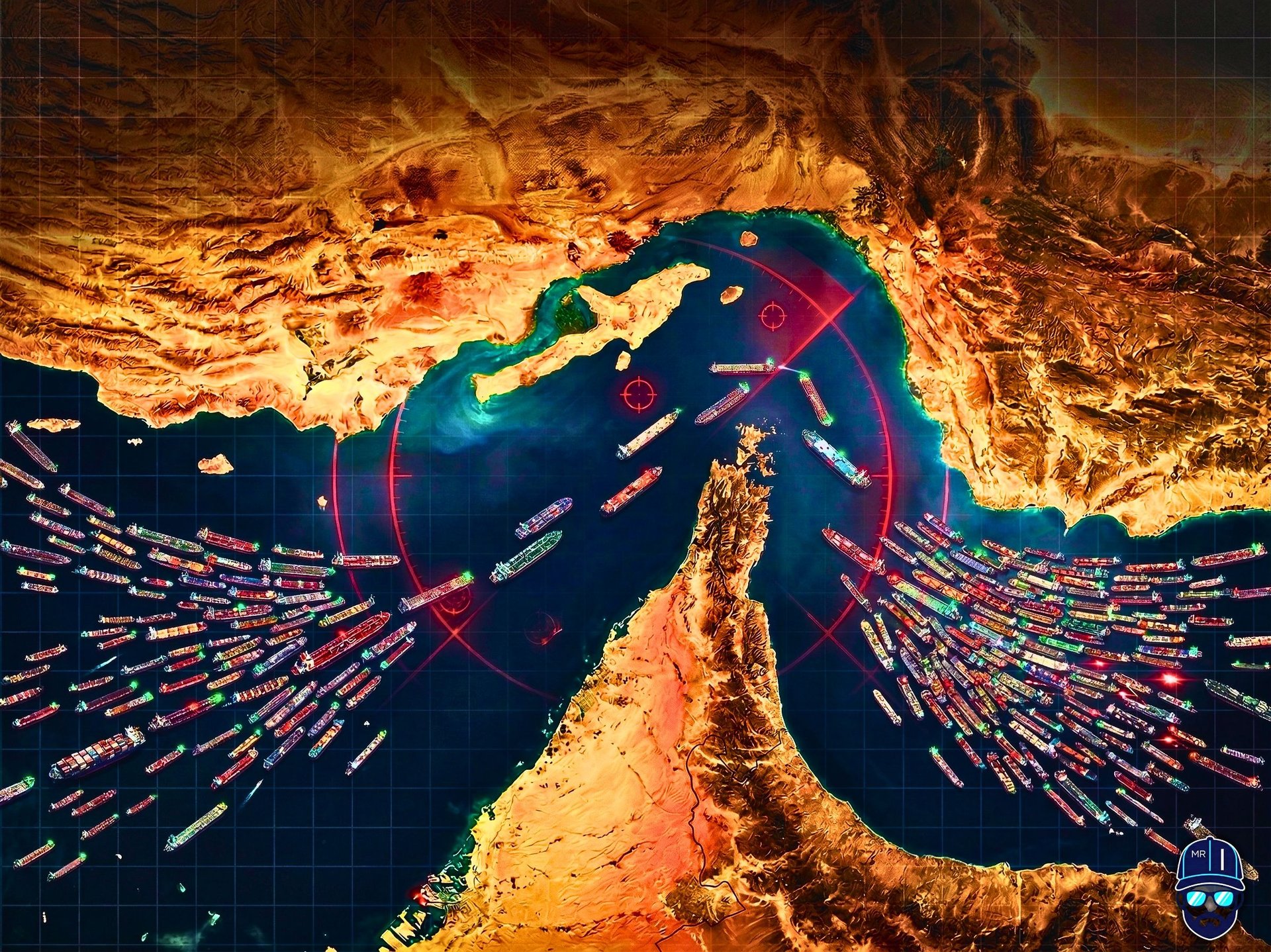
The Invisible Chokepoint: How the Strait of Hormuz is Engineering a Global Food Collapse
You think the crisis in the Middle East is just about the price of gas? Think again. A 33-kilometer strip of water is holding the very chemistry of our food supply hostage. From frozen supply chains to the high-pressure alchemy that feeds 40% of the world, discover why the next global shock won't just hit your wallet—it will hit your plate.
Mr. Influenciado
3/6/20264 min read
We look at the map of the Middle East and we see energy. We see oil fields and pipelines. But look closer, beneath the geopolitical noise, and you'll see the calories on your dinner plate.
Welcome back. Pull up a chair, adjust your baseball cap, and let's look at the grid. I’m \MrInfluenciado, and today we are tearing down the facade of global supply chains. The Strait of Hormuz is widely known as the world's most critical oil artery, but that is only half the story. The real crisis brewing in the Persian Gulf isn't just about what leaves the region; it's about what goes in, and the chemical chain reaction that keeps human civilization from starving.
The 33-Kilometer Bottleneck
The Strait of Hormuz is a geographic anomaly. At its narrowest, it is just 33 kilometers wide, with shipping lanes a mere 3.2 kilometers wide in either direction. Under normal conditions, 138 ships navigate these waters daily, carrying 20 million barrels of petroleum out to the world.
But trade is a two-way street. The Gulf Cooperation Council (GCC) countries reside in hyper-arid environments. They are agricultural deserts, importing a staggering 78% to 85% of the food their populations consume. As geopolitical friction between the US, Israel, and Iran escalates, this artery has paralyzed. Giants like Maersk and Cosco have suspended operations in the area. We are looking at a localized "effective closure."
The immediate result? Over 150 tankers are currently anchored, waiting for security guarantees. Freight costs are surging by $1,500 to $3,500 per container. Insurance premiums have skyrocketed. With reserves limited to just a few months, there is a very real, dystopian probability that, locally, basic food staples could soon become more expensive than crude oil.
The Chemistry of Survival: Turning Air into Bread
To understand the global threat, we have to look past the shipping containers and into the molecular foundation of modern agriculture.
Before the 20th century, the world relied on guano—bird and bat excrement—as the primary source of agricultural nitrogen. Navies protected islands covered in bird feces because nitrogen meant food, and food meant power. But guano was an environmental nightmare and logistically abysmal.
Enter the Haber-Bosch process. Developed in 1908 by physicist Fritz Haber and scaled industrially by Carl Bosch in 1913, this was arguably the most consequential scientific breakthrough in human history. It allowed us to pull nitrogen directly from the air and bind it with hydrogen to create synthetic ammonia.
This requires extreme conditions: roughly 450°C and crushing atmospheric pressure. But where does the essential hydrogen—and the massive energy required to heat the furnaces—come from? Natural gas. Natural gas isn't just fuel; it is the fundamental ingredient for fertilizer. Without it, the Haber-Bosch process stops. Without Haber-Bosch, global food production plummets. When combined with medical advances like Alexander Fleming's discovery of penicillin, which drastically reduced infant mortality, synthetic fertilizers are the only reason the Earth can sustain a population of 8 billion.
Ammonia is a dual-use chemical. In World War I and II, it was diverted from farms to munitions factories to create explosives. When fertilizer vanishes, famine follows. We saw this during the brutal Dutch Hunger Winter of 1944-1945, where blockades and freezing temperatures killed 20,000 people. Similar historical tragedies echoed through Kyiv and Beijing when agricultural inputs collapsed.
The 2026 Qatar Shockwave and the European Winter
This brings us to the present danger. Qatar is the titan of Liquefied Natural Gas (LNG), historically responsible for up to 25% of the global supply. With recent drone offensives hitting infrastructure in Ras Laffan—the "capital of LNG"—QatarEnergy has been forced to halt operations to assess the damage.
Europe is exceptionally vulnerable here. Trying to pivot away from Russian gas, Europe heavily relies on the Gulf. With Ras Laffan compromised and Hormuz choked, Europe faces a brutal compounding crisis: astronomical electricity and heating bills, alongside a massive spike in agricultural inflation. They can't simply drill their way out, either. Europe's domestic options are fraught; the Groningen gas field in the Netherlands, for instance, has triggered earthquakes since 1990 (peaking at a 3.6 magnitude in 2012), forcing severe limits on extraction to prevent structural collapse.
The Brazilian Paradox
If you want to see the ultimate vulnerability of this system, look at Brazil.
Brazil is a global agricultural superpower, feeding billions. Yet, it operates on a razor's edge. Despite having domestic natural gas reserves, Brazil lacks the industrial infrastructure to manufacture synthetic fertilizers at scale. The country imports 85% to 90% of its nitrogen fertilizers.
Crucially, Iran is a massive supplier, providing between 1.3 to 2.7 million tons of urea (about 16% of Brazil's imports). If the Strait of Hormuz remains locked down, the Brazilian agrobusiness engine stalls. You can have all the fertile land and water in the world, but without urea and ammonia, crop yields collapse. If a disruption lasts longer than a few days, prices explode; if it lasts 3 to 6 months, we are looking at a systemic global food shortage.
Can we bypass the Strait? Geopolitical megaprojects suggest we can, but reality disagrees.
The India-Middle East-Europe Economic Corridor (IMEC) and China’s Belt and Road Initiative (BRI) are ambitious overland and maritime "superhighways." However, they are fundamentally unequipped to handle the sheer volume of bulk commodities like LNG and the 34% to 50% of the world's fertilizer that transits via Hormuz. You cannot put millions of tons of explosive, highly pressurized ammonia on a train crossing multiple unstable borders and expect the same efficiency as a supertanker.
The world is a fragile machine. A drone strike in Ras Laffan or a naval blockade in a 33-kilometer strait doesn't just mean your gas bill goes up. It means the complex chemical pipeline that turns fossil fuels into the food on your table gets severed.
We are one sustained disruption away from a cascading supply chain failure that mirrors the worst days of the pandemic, but with stakes measured in human starvation rather than toilet paper.