
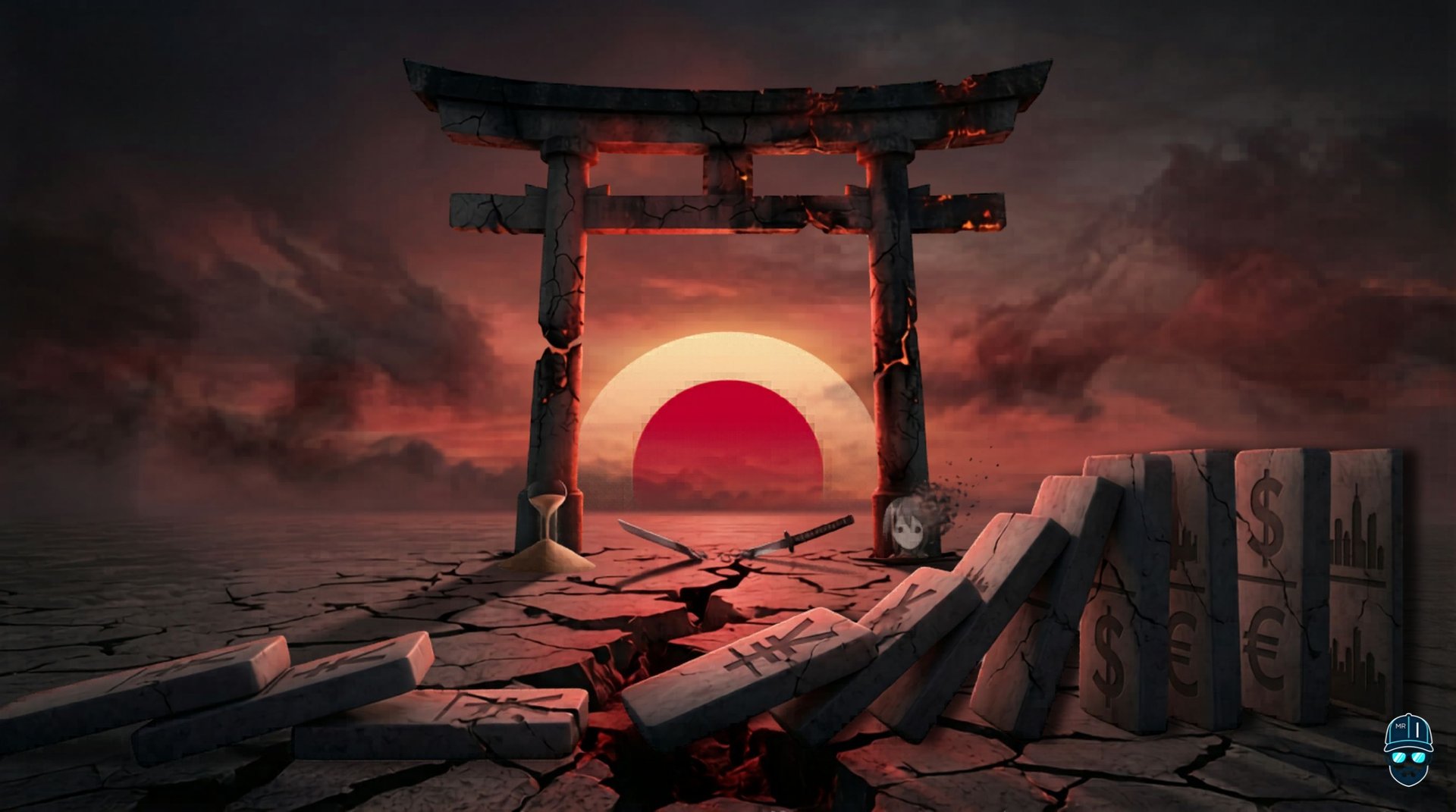
The Japan Risk: How an Economic Time Bomb Threatens the World
Japan was the future. Now, staggering debt and a demographic time bomb threaten to trigger a global economic collapse. Discover the hidden risks of a world without the Rising Sun.
Mr. Influenciado
4/1/20265 min read
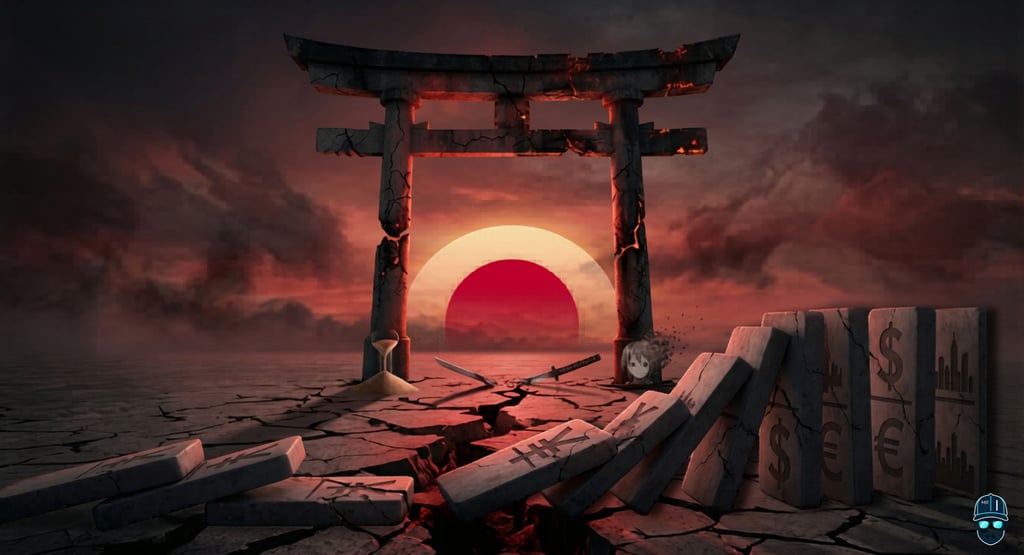

Japan is a living paradox. An island nation that overcame sheer scarcity and nuclear devastation to become the planet’s technological and cultural epicenter. However, behind Tokyo's neon lights and the efficiency of its bullet trains lies one of modern geopolitics and macroeconomics’ greatest time bombs.
We are not just talking about an isolated crisis; we are facing a structural failure in one of the world's primary engines. Japanese stagnation carries the potential for a chain-reaction collapse that could rewrite the global economy and erase one of humanity’s greatest hubs of cultural influence.
To understand the approaching abyss, we must first look at the bedrock upon which this empire was forged.
The Island's Forge and the Philosophy of Resilience
Geography is a nation's destiny, and Japan's destiny has always been defined by scarcity and isolation. With only 15% arable land on a territory smaller than California, now housing over 122 million people, survival demanded brutal adaptation. From space optimization in the Tokugawa era (1600–1868) to post-WWII reconstruction, the Japanese response to the hardships of nature and history was the cultivation of extreme resilience.
This reality forged a deep-seated mentality. The need for cooperation in rice harvesting and surviving earthquakes created a society where the collective invariably surpasses the individual. It is an almost stoic approach to existence: absolute self-mastery, duty (giri), and relentless perseverance in the face of adversity (ganbaru). This constant pursuit of perfection translated into the concept of kaizen (continuous improvement), the engine of the Japanese industrial miracle.
However, virtue taken to an extreme becomes a vice. The same social harmony that rebuilt the country has created paralyzing institutional rigidity. A culture that prioritizes consensus above all else today stifles disruptive innovation and impedes the painful, yet necessary, reforms needed to save the economy.
The Cyberpunk Peak and the Bursting of the Bubble
To understand the fall, one must remember the summit. In the 1980s, Japan was not just an economic powerhouse; it was the future materialized. Dominating the electronics, robotics, and automotive industries, Japan set the pace for the global technological vanguard. Japanese megalopolises, with their hyper-technological corporate aesthetic, became the embodiment of and primary inspiration for the cyberpunk imagination of seminal works like William Gibson’s Neuromancer. The modern digital world we inhabit today was imagined there first.
But the future extracted its price. The 1985 Plaza Accord forced the yen's appreciation, leading the Japanese government to inject cheap credit into the market to protect its exports. The result was one of history’s largest asset bubbles. The frenzy was such that, at its peak, the land beneath the Imperial Palace in Tokyo was worth more than the entire California real estate market.
To halt speculation, the Bank of Japan (BoJ) raised interest rates in 1989. The result was a financial bloodbath. Stocks and real estate plummeted 60% by 1991. Japan entered the so-called "Lost Decades," a long winter of deflation, artificially maintained "zombie" companies, and stagnation from which it has never fully recovered.
The Macroeconomic Abyss and Systemic Risk
Today, Japan is the epicenter of a colossal financial anomaly. The country's public debt has reached an absurd 236.7% of GDP, with projections to remain at suffocating levels. Why haven't they gone bankrupt? Because this debt is financed internally, with interest rates kept artificially near zero.
As of March 2026, the BoJ is operating with rates at 0.75%, in a desperate struggle to control 2% inflation and a weakened yen. And this is where the risk of global contagion lies: the Yen Carry Trade.
For decades, investors worldwide borrowed money in Japan at near-zero interest rates to invest in high-yield assets (tech stocks, US Treasury bonds, emerging markets) around the globe. Trillions of dollars are tied to this dynamic.
If the Bank of Japan is forced to drastically increase interest rates (to 1% or more) to save its currency or contain inflation, the house of cards collapses. The servicing cost on a debt exceeding 250% of GDP would be unpayable for the government. Globally, investors would be forced to liquidate trillions in assets to cover their loans in Japan, triggering a crash in Western stock markets, drying up global liquidity, and dragging emerging economies into the abyss.
The Demographic Time Bomb
The economy, however, is merely the symptom; the actual disease is demographic. Japan is shrinking and aging at a terrifying pace.
The total population has fallen to 122.4 million, with continuous negative growth.
The fertility rate is at a meager 1.20 children per woman (far below the 2.1 needed for population replacement).
A staggering 30% of the population is 65 or older. The dependency ratio reaches 70%.
A nation without youth is a nation without a future. A workforce that has been shrinking for three decades collapses the pension system, drains domestic consumption, and, most critically, stagnates innovation. While the world surges forward furiously in Artificial Intelligence, Japan struggles against labor shortages in manufacturing and basic care, unable to offset the deficit due to deep cultural barriers against mass immigration.
Soft Power and the World's Moral Compass
Despite its relative industrial decline, Japan's influence over the human imagination has never been greater. Japanese soft power is a hegemonic cultural force. With over 1 billion hours of anime and manga consumed globally every year, Japan exports much more than entertainment; it exports a moral system.
For young people in both the West and East, Japanese pop culture has become a pillar of character formation. Epic narratives often center on the ethics of studios like Ghibli, on self-mastery, honor, and resilience in the face of sheer tragedies. In a global era marked by cynicism and fragmentation, Japanese heroes teach new generations the value of unwavering effort and creating meaning (ikigai). Japan’s aesthetic and practical philosophy still shapes everything from our electronics design to our productivity routines.
The Dystopian Scenario: A World Without Japan
What happens if the thread snaps? Imagine a synchronized collapse where debt suffocates the state and a lack of youth paralyzes the country. A world where Japan becomes irrelevant is a dystopian scenario with brutal ramifications.
Supply Chain Collapse: Japan remains an anchor in manufacturing advanced industrial robotics, precision machinery, and crucial semiconductor inputs. A Japanese logistical blackout would paralyze automotive and hardware assembly lines worldwide.
The Financial Earthquake: The abrupt unwinding of the Yen Carry Trade would liquidate trillions of dollars in international markets, evaporating capital from stock exchanges in New York and São Paulo within days.
The Cultural and Moral Vacuum: The absence of Japan’s soft power machine would leave a vacuum in entertainment and the moral compass of an entire global generation, which would lose access to a culture that has, for decades, silently taught the world not to give up.
The Empire of the Rising Sun is facing twilight. Without radical reforms or a technological miracle, Japan risks entering not a "lost decade," but a "lost century." And if Japan falls, the modern world they helped design will feel the tremor beneath its feet.